
Acedia: Active Passivity in Robert Bresson’s The Devil Probably
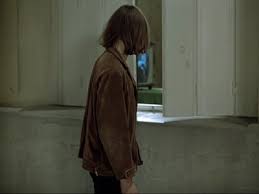
Rainer Werner Fassbinder begins his film “The Third Generation” (1979)—his second film about the Red Army Faction, the production of which began just months after the deaths of Baader, Meinhof, and Ensslin—with a scene from Bresson’s “The Devil Probably.” We see a television screen broadcasting the final scene of “The Devil Probably,” where Charles has sought Valentine’s help to end his life.
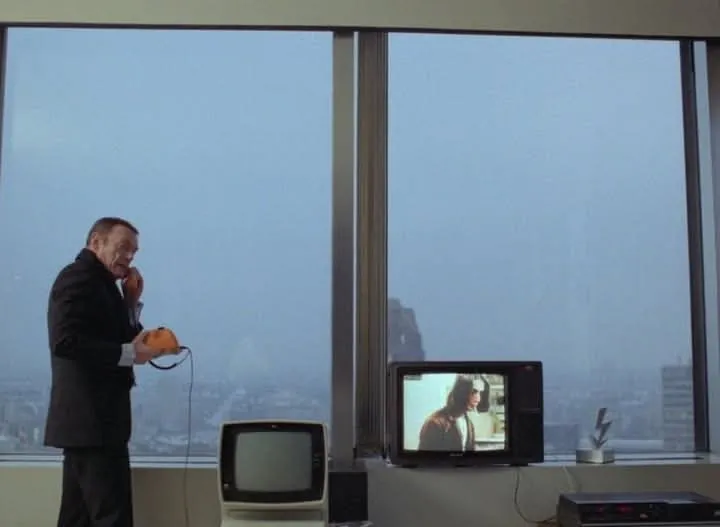
The television sits in an office in a high-rise building, positioned against a window. We observe Charles’s face against Berlin’s empty sky, detached and unconnected to the earth, as if bearing no relation to the city’s political and social fabric. What theme did Fassbinder find in “The Devil Probably” that led him to begin his narrative of one of the most radical contemporary revolutionary groups with it?¹
But let us begin with the opening of Bresson’s film itself. We see a pleasure boat passing under a bridge. A shot similar to one we had seen in another of Bresson’s later films about Parisian youth: “Four Nights of a Dreamer” (1971).
This time, however, there is neither news of the sun’s glimmer in Parisian days nor of sparkling eyes in its passionate nights. We observe a withered post-May ’68 Paris whose river is a dark ribbon where weapons and drugs are sold. Gray is the dominant hue of the city. Apart from the clothing of the film’s models/actors, the asphalt, the bathrooms, the telephones, the walls, the cars, and the sky all lie under the dominion of gray tones.
As if these gray hues are the continuation of toxic material leaks and pollution that we see in the environmental meeting videos within the film, having now seeped into the characters’ bodies and the city’s form. From another perspective, they could also recall Gerhard Richter’s quote: “Grey is the only existing equivalent for indifference, withdrawal from commitment, absence of opinion, formlessness.”² From this perspective, gray is the motif of indifference.
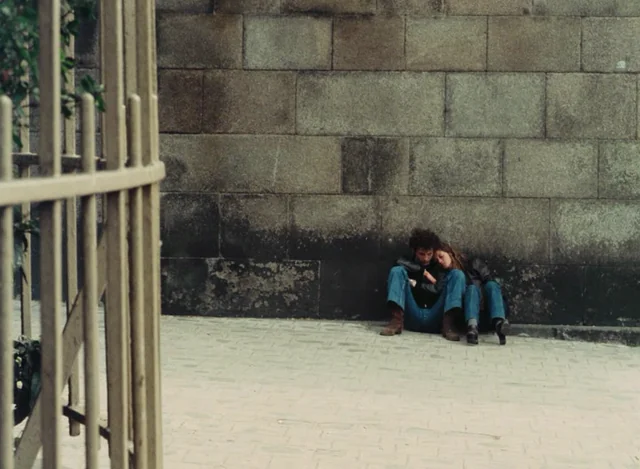
Indifference and refusal of any intervention in political and social matters has been one of the central axes of debate about Bresson’s film. Now we can return to the initial question once more. What revolutionary capacity could a film possess whose main character seeks a life outside the socio-political sphere? Or why were there extensive efforts to censor or prevent its screening? Should we accept the state’s puritanical gesture in confronting the film as merely discouraging youth suicide? Is this the first time a young character in a Bresson film commits suicide?³ Can’t the main source of fear about “The Devil Probably” and Charles be found somewhere beyond these moral concerns and affectations of the state?
“The Devil Probably” finds that approach from which one of the most radical contemporary revolutionary groups can be narrated with it. What does it begin with?
With Charles’s final refusal of Bresson’s film, we are no longer witness to a critical perspective on the film’s speeches and present ideologies. Perhaps this critical perspective exists most powerfully in the scene where films about pollution are shown in environmental meetings. When the showing ends, a member of the meeting says, “This is terrible. We must react.” But the reaction they expect is neither from Michel, who answers, “We already know all this,” nor from the others present in the hall.
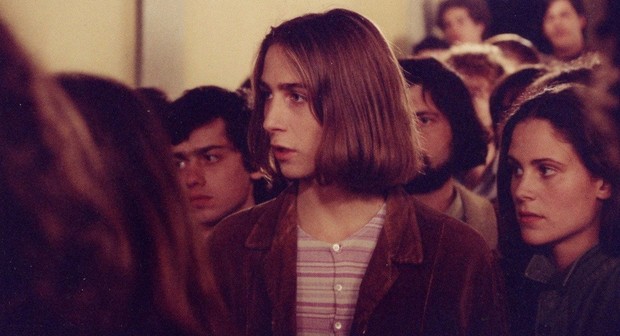
Bresson approaches the issue from another angle. His camera exits the hall and follows Charles, who had left during the screening. In another scene as well, one of the film’s young revolutionaries proudly tells Charles about actions they’ve undertaken.
Charles responds that what they’re doing is meaningless and futile, adding in another scene that he doesn’t know how to oppose destruction. What depresses Charles is not this meaningless opposition itself, but that it has meaning for others.
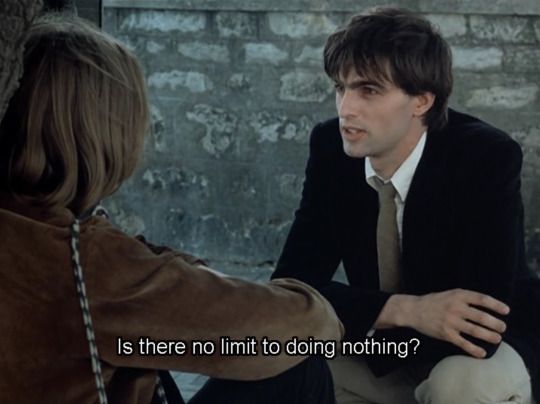
The film is replete with such encounters where Charles refuses any joint action with present ideological groups, including his friends. Yet what makes Charles so fascinating to Bresson is not his nihilism; it’s his position vis-à-vis these refusals and negations. Charles’s suicide is not an individual erasure but the annihilation of a generation that finds itself caught between two fires: on one hand, participation in futile actions, and on the other, falling into the abyss of nihilism. It’s clear that for Charles, one of these paths is not an option.
The other generates no satisfaction. In the middle of this whirlpool, between the church, the psychiatrist, and revolutionaries, he finds no way except self-destruction, except a flight to nothingness.
Brian Price, in his book “Neither God nor Master: Robert Bresson and the Politics of the Radical,” explains that the actions and specifically the crimes that characters in Bresson’s films commit were an effort to free themselves from the guardianship of church, police, state, and enemy [“A Man Escaped” (1956)], and through a kind of criminal autonomy, to create a world distinct from the one in which they were under control and domination, and thus their actions/crimes were a form of freedom.
In “The Devil Probably,” however, Charles refrains from reciprocal action with various ideologies and movements throughout the film—radical political movements, environmentalism, sexual freedom, debates about Christianity’s relationship with the modern world, nihilism—none arouse any desire for action or expression in Charles.

Related Posts
Nothing found.